Monday, 14 January 2013
Each trip brings something new
It seems that each time I travel I learn something that will help me on my next journey. This trip to the South Pacific taught me something about rain. Prior to this, my presence in a warm climate never seemed to involve a downpour. But, as I mentioned, December in the South Pacific is the rainy season. But it is also quite warm and humid. So, I wore shorts everywhere. Which meant I got caught in monsoon-like rain trying to board the ferry from Moorea to Tahiti. I had to remove the electronic device that I wear on my leg to help me lift my foot. Otherwise, it likely would have shorted out. This required, then, that I walk up a very large ramp (with help) in the pouring rain without my walking device. I was very nervous and, frankly, a tad annoyed that this was the only way they seemed to have available to board the vessel for persons with a mobility issue. Nevertheless, I made it onboard without ruining my device. When I arrived back in Canada, I contacted a dear friend who is quite skilled with a needle and thread. She is in the process of making a cover for my device that will be easy to carry and quick to put on. It will simply be a strip of windbreaker (or something even more waterproof) fabric with elastic on the top and bottom to make sure it hugs the leg. At each end, it will close with velcro. So, no bulk and I can slap that thing on in a matter of seconds. So, whatever sort of exposed electronic device you may have, velcro is a marvelous invention and might be a useful part of keeping it dry. Think about it.

La Villa des Sens, Moorea
My husband just stumbled on this restaurant in an obscure brochure and a good thing too as it was absolutely the best eatery we visited. The style of cooking was focused more on the French than the Polynesian but, with the incredibly fresh resources available, La Villa des Sens was a fabulous surprise. We looked at the a la carte menu and it appeared to be delicious but, as it was Christmas Eve, we decided to have the special pre-fixe menu.
The first course was a red mullet with grilled vegetables, arugula, basil and black olives. These flavours together were wonderful and the fish was so fresh, cooked moist to perfection. The second course was prepared beautifully - a shellfish soup and green penne pasta. In a soup, often the shellfish ends up overcooked but not in this case. The main course was a first for me; oven roasted Bresse capon (yes, these are the famous blue-footed chickens from France), polenta and truffle galette and carrots and turnips candied in honey. This course was the exact balance of savory and sweet and the bird was perfectly moist and tender. And no, the feet were not included. The dessert course was what I often refer to as "slap yo mama" good. My husband claims that it's the best dessert he's ever had. It was an exquisitely risen and light chestnut soufflé with mille-feuilles, or simply put, three layered ice cream of chocolate, vanilla and pistachios with rum sauce. Something akin to the classic French Napolean pastry. Now, I really don't care for all this text-speak but OMG!! This was the kind of dessert that makes your eyes roll back in your head.
La Villa des Sens is on the Legends Resort property across the road from the Intercontinental. It's a very easy walk or, if you're like me and can't walk very far, they will actually pick you up and drop you off in a golf cart. The dining room is lovely, using the locale to its best advantage. To start , the outer walls are open with awnings if needed in case of rain. So, all the lush foliage surrounding the structure is part of the experience. As is the moon, which presented itself in full on the night we were there. The interior had inlaid stone walls and warm dark wood floors. The lighting was diffused, coming primarily from long, narrow fixtures hanging from a high ceiling. And the owners have chosen some very intriguing abstract paintings that decorate several areas of the room. This was the perfect way to end our South Pacific adventure.
The first course was a red mullet with grilled vegetables, arugula, basil and black olives. These flavours together were wonderful and the fish was so fresh, cooked moist to perfection. The second course was prepared beautifully - a shellfish soup and green penne pasta. In a soup, often the shellfish ends up overcooked but not in this case. The main course was a first for me; oven roasted Bresse capon (yes, these are the famous blue-footed chickens from France), polenta and truffle galette and carrots and turnips candied in honey. This course was the exact balance of savory and sweet and the bird was perfectly moist and tender. And no, the feet were not included. The dessert course was what I often refer to as "slap yo mama" good. My husband claims that it's the best dessert he's ever had. It was an exquisitely risen and light chestnut soufflé with mille-feuilles, or simply put, three layered ice cream of chocolate, vanilla and pistachios with rum sauce. Something akin to the classic French Napolean pastry. Now, I really don't care for all this text-speak but OMG!! This was the kind of dessert that makes your eyes roll back in your head.
La Villa des Sens is on the Legends Resort property across the road from the Intercontinental. It's a very easy walk or, if you're like me and can't walk very far, they will actually pick you up and drop you off in a golf cart. The dining room is lovely, using the locale to its best advantage. To start , the outer walls are open with awnings if needed in case of rain. So, all the lush foliage surrounding the structure is part of the experience. As is the moon, which presented itself in full on the night we were there. The interior had inlaid stone walls and warm dark wood floors. The lighting was diffused, coming primarily from long, narrow fixtures hanging from a high ceiling. And the owners have chosen some very intriguing abstract paintings that decorate several areas of the room. This was the perfect way to end our South Pacific adventure.
 |
| courtesy of www.legendsresortvillas.com |
Papeete, Tahiti December 2012
Our primary purpose for visiting French Polynesia was to go on a cruise but we spent a few days before in Papeete, Tahiti and a few days after on the island of Moorea. In general, these islands feel like a wilder, more primitive version of the Hawaiian Islands - something before the over-development began in earnest. We discovered that the economy of French Polynesia has been very effected by both the U.S. and European struggles; many restaurants have simply folded, their French chefs having given up and returned home. Further, we were present during the rainy season so, although we didn't really lose anything to rain, it was more overcast than we like. And these islands don't get the trade winds like Hawaii so the air is much more humid and a haven for mosquitoes. So, if you're like me, you might want to bring insect repellant and certainly something for the bites. I recommend Burt's Bees Outdoor Bug Bite Relief. It's a simple solid stick, nothing liquid, so it can be carried in hand luggage and, most importantly, it works.
All that being said, we definitely enjoyed this trip - the islands are beautiful, lush, full of history - a very interesting experience. I think it is best to start the French Polynesian tour in Papeete. It's the main city for all the islands and has some fascinating things to see. We hired a private car and driver to get a sense of our location and our driver, Fifi (yes, that was her name!), was friendly and knowledgeable.


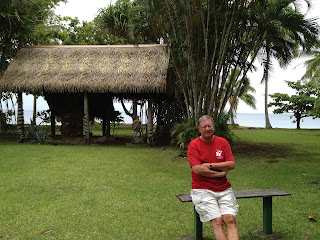


All that being said, we definitely enjoyed this trip - the islands are beautiful, lush, full of history - a very interesting experience. I think it is best to start the French Polynesian tour in Papeete. It's the main city for all the islands and has some fascinating things to see. We hired a private car and driver to get a sense of our location and our driver, Fifi (yes, that was her name!), was friendly and knowledgeable.

Our first stop was the Paul Gauguin Museum. Gauguin was a French post-impressionist painter (1848-1903) whose interest in the primitiveness of these islands and their exotic women made it a major focus of his work. The museum was small and primarily comprised of outdoor structures. The exhibits were housed in three buildings that covered the artist's life, work and those pieces that were on loan from other museums and galleries. My husband's favourite Gauguin painting, Contes Barbares (1902), just happened to be there, on loan from Museum Folkwang in Essen, Germany.

The grounds around the structures were quite welcoming with benches and beautiful vistas. It's a well presented museum, keeping with the spirit of Gauguin's inspirations and creations.

Our second stop was at one of two botanical gardens along Papeete's main road. As expected, lush foliage everywhere but beautifully laid out along simple walking paths. Tall vine covered trees towered above and ripening breadfruit hung overhead. There were brilliant colours in the reds and pinks of the wild ginger and we were there just in time for the blossoming of the Chinese Lanterns. Apparently, this only happens once a year.


The petit waterfall is a focal point of this garden, not far up the path. The sound of the water was prevalent from the moment we arrived so finding its source was a priority. It's not a large deluge but it's a lovely, pristine little spot.

Lastly, Fifi took us to the remains of an ancient Polynesian temple, or Marae. This is not what we westerners think of as a temple. There is no physical building. What you see is a collection of stones laid out on the ground in a large area on which priests and leaders gathered and stood to worship and discuss community issues. In between the stones, stand thin red markers that represent the gods of this sacred area. At the entrance to this open area stands a very stern looking statue; he appears to be guarding his land.


There are now two sections of bleachers near the stones as the spot is used for community and cultural events today.
We saw several Polynesian sites as well as pearl farms and vanilla plantations on the islands of Raiatea, Taha'a, Bora Bora and Moorea via the cruise so we looked forward to spending some time by the pool when we disembarked in Moorea. I don't normally discuss the pros and cons of hotels as it usually isn't worth it, however, I want to tell you how beautifully appointed and comfortable the Intercontinental Hotel is both on Tahiti and Moorea. We were very well looked after in both and their pools are exquisite. Although I am unable to stay in them, the over-water bungalows are gorgeous, the perfect romantic getaway.

And finally, if you visit the island of Moorea, you must be sure to see Bali Hai. Yes, the movie was filmed on Kauai but the peak is here.
 |
| It's the one on the right |
Tuesday, 11 December 2012
The Well of the Turk, Hania
This restaurant serves phenomenal fresh, organic food in the Turkish district of Hania known as Splantzia. The historical building lies amongst a "labyrinth of narrow streets" on Rouga Square and houses The Well of the Turk and a marble fountain depicting scenes of Istanbul. This establishment is truly enthralling and I am amazed at its efficiency as the kitchen is up a flight of stairs on the second floor. Although there is a lovely dining room inside, the breezy tables outside are preferable and the patio wraps around to an intimate side street too narrow for cars.
The restaurant's owner, an ex-pat from the UK, creates wonderful, flavourful dishes from Middle Eastern and Mediterranean influences. Having lived in Morocco learning about cuisine from a good friend, she provides the unique spicing and textures from this culture. The Greek influence comes from her mother-in-law when she first arrived in Greece; it was through food that she learned the language.
Our appetizer was the freshest, flavour-popping salad I've ever had. Along with organic greens, avocado, oranges and black olives were tossed with crunchy flakes of Greek sea salt. The Mid East/Med spices combined beautifully first with chicken and bacon kabobs and then with a spinach, cheese, almond and raisin crepe pie. Plumpness, crunch, creamy - all together in a warm nest. The owner, Jenny, brought marvellous food and took us on the grand tour. The Well of the Turk was a terrific surprise.
The restaurant's owner, an ex-pat from the UK, creates wonderful, flavourful dishes from Middle Eastern and Mediterranean influences. Having lived in Morocco learning about cuisine from a good friend, she provides the unique spicing and textures from this culture. The Greek influence comes from her mother-in-law when she first arrived in Greece; it was through food that she learned the language.
Our appetizer was the freshest, flavour-popping salad I've ever had. Along with organic greens, avocado, oranges and black olives were tossed with crunchy flakes of Greek sea salt. The Mid East/Med spices combined beautifully first with chicken and bacon kabobs and then with a spinach, cheese, almond and raisin crepe pie. Plumpness, crunch, creamy - all together in a warm nest. The owner, Jenny, brought marvellous food and took us on the grand tour. The Well of the Turk was a terrific surprise.
 |
| courtesy of www.welloftheturk.com |
Crete, Greece 2010/2011
 |
| courtesy of www.lonelyplanet.com |
This month's entry is somewhat different - we're going on a brief tour of the island of Crete. This is the largest of the Greek islands and the most southerly, sitting between the Aegean and Libyan Seas. Crete is Greece's most populaces island as well and, as you can see by the map, divided into four regions. Cities in three of them will be discussed here.
Iraklion (Heraklion)
Iraklion is the largest city on Crete and its administrative capital. It has a lively port where ferries and cruise ships dock.

What makes this an important centre is its proximity to the ruins of the Palace of Knossos. These city remains are considered to be from one of the very first civilizations (approx. 2700 BCE). Developed by the Minoans, feats of engineering such as running water are some of their most prominent accomplishments. The ruins are controversial as their discoverer, Arthur Evans, made attempts to restore parts of the area to show what this civilization may have looked like. Nonetheless, the developments uncovered here prove that the Romans were not the first masters of engineering and artistry.


Iraklion's public bus was an extremely efficient method of getting to and from the site. It leaves from the bus station right at the port and drops passengers off virtually at the entrance to the ruins.
Iraklion hosts the Archaeology Museum that houses the brilliant creations of the Minoans that were unearthed at Knossos. Although the Museum was under massive renovation (this is Greece, nothing happens with any expediency), the most famous pieces were moved to a temporary chamber at the back of the facility for viewing. The images of dancers jumping over a bull can be found on frescoes and funereal scenes on the sides of sarcophagi. The meticulously detailed bee pendant is also on display here. The Minoans' ability to work with such tint elements is a true marvel.


With a number of interesting shops and restaurants, Iraklion is a fascinating place to begin a visit to Crete.
Hania (Chania)
Hania is a charming town where much of its activity involves the marina, full of small fishing vessels and tour boats. Much of the harbour is protected by a stone wall leading out to a petit nut functional lighthouse. Numerous outdoor restaurants and shops wind their way along the lengthy harbour area.


On one side of it sits what appears from the outside to be a tall warehouse building. Once inside, however, a wonderful discovery is made. This is, on the surface, the Maritime Museum of Crete-Chania. Ah, but it is so much more. The high, long room really only focuses on one thing - the re-creation of a Minoan ship. The seafaring experts of Hania took on this massive project as a presentation for the 2004 Athens Olympics. The research about how the beams were shaped, how the individual pieces were held together, the waterproofing, the making of a sail, etc., was an enormous undertaking, not to mention the historical accuracy with which it was built. The completed ship is a phenomenal homage to yet another brilliant Minoan accomplishment. Unfortunately, the project was deemed to be inauthentic and ship was never rowed into Piraeus Harbour. It now sits in the Museum, a testament to the devotion and commitment to history.

On our last day in Hania, we took a day tour from the small port of Kissamos on a lovely tour vessel with beach chairs and towels. Our first stop was at Gramvousa where a Venetian castle sits atop the hill overlooking a serene beach. The second stop was at the Balos Lagoon. This exquisite shallow bay was wonderfully warm, heated by the sun and the sand went on for miles; even between the boat and the lagoon there was a deep stretch of sand and stones. It was a relaxing ride with lunch provided and plenty of sunbathing.

Agios Nikolaos
Agios Nikolaos is one of the most picturesque ports that we've visited. We were only here for the day but we are determined to return. The town has a dock that allows small cruise ships to anchor right in the middle of town. Beautiful trees and gentle hilly streets define this charming place.

Our primary focus of the afternoon was a special lunch recommended by a Greek friend but, upon her additional recommendation, we visited a wonderful gallery and shop - Atelier Ceramica. What a treasure trove this turned out to be. Up an unassuming street was a small storefront bursting at the seams with amazing creations. Artist Nic Gabriel creates artifacts and replicas in the ancient Greek style, according to their history and using time-honoured, colourful techniques. Each one has an historical period and description on it somewhere. Gabriel works on pieces from a number of eras - the early Minoan to the Hellenic period; anything from frescoes to pottery to ceramics. His studio is his gallery and his gallery is his shop. On any given day, you will find Gabriel there working away. The most difficult thing was what to choose - I wanted them all!

Wednesday, 14 November 2012
Hop On Hop Off
For those of you who find it difficult to simply walk around in a new destination or you just want a good way to orient yourself, many cities now have a "Hop On Hop Off" bus system or its equivalent. This is an easy and very budget-conscious way to see your destination, taking in all the major sights. The bus usually has a number of stops and some systems even have several different routes. This allows the rider to get on and off at any point along the tour, numerous times, during a 24 hour period. It may be helpful to take this journey shortly after your arrival in order to see the areas to which you may wish to return. The fares are very reasonable and tickets can be purchased usually online or on the bus itself. Often your fare includes the purchase of headphones, allowing you to listen to commentary about the city in several different languages. I've experienced these systems both in North America and in Europe so do your homework to see if it's available on your next trip.
Coyote Cafe, Santa Fe
This restaurant is notable, not only for its vibrant cuisine, it is also the source of the Southwest style of cooking. In 1987, Chef Mark Miller created the Modern Southwest Cooking style here; a fusion of flavours and recipes that was popular with cowboys, Native Americans, Spanish colonial settlers and Mexicans throughout the 16th century.
The cafe's ambience is very warm and, due to the style of the cuisine, the adobe architecture is quite prevalent. Throughout, the guests are enveloped in a cozy orange light. Its ceiling is very high and has a series of glass rectangles hanging in various colours by thin wires. Each one is rippled, seeming to represent birds flying overhead. Above the open kitchen area, a video of fireplace flames is projected on the wall, adding not only to the warmth of the room, but in some cases, the heat of the food.
Which is, as always, most distinct. We started with an organic baby lettuce salad with pears and pecan brickle in a cider vinaigrette. A tasty twist on a classic. We also sampled a fabulous rare ahi with foie gras. The first main course resonated with some of that "heat," a fiery white shrimp and rice cake with basil aioli. The second was a mesquite grilled lobster tail. Don't think Chappy would have barbecued that on the back of the chuck wagon. Round 'em up, boys!
The cafe's ambience is very warm and, due to the style of the cuisine, the adobe architecture is quite prevalent. Throughout, the guests are enveloped in a cozy orange light. Its ceiling is very high and has a series of glass rectangles hanging in various colours by thin wires. Each one is rippled, seeming to represent birds flying overhead. Above the open kitchen area, a video of fireplace flames is projected on the wall, adding not only to the warmth of the room, but in some cases, the heat of the food.
Which is, as always, most distinct. We started with an organic baby lettuce salad with pears and pecan brickle in a cider vinaigrette. A tasty twist on a classic. We also sampled a fabulous rare ahi with foie gras. The first main course resonated with some of that "heat," a fiery white shrimp and rice cake with basil aioli. The second was a mesquite grilled lobster tail. Don't think Chappy would have barbecued that on the back of the chuck wagon. Round 'em up, boys!
 |
| courtesy of www.finetravel.com |
Subscribe to:
Posts (Atom)