Showing posts with label Home. Show all posts

Saturday, 24 January 2015

Easter Island - Christmas, 2014

Yes, a visit to Easter Island at Christmas, actually, it was Christmas Eve but why quibble. Otherwise known as Rapa Nui, most of the island is a national park and protected as a World Heritage site. It belongs to Chile even though it sits 2300 miles (3700 km) off the country's west coast. And what a truly marvellous place it is.

Our guide (seen below), Edmundo Edwards, is an archaeologist who has lived on the island for fifty years and has worked on many of the excavations. Needless to say, we felt very well informed by the end of the day.


Isn't that the best name!


Our first stop was at Rano Kau. This is an extinct volcano that looks nothing like any crater I've ever seen. The general environment of Easter Island is dry and breezy - surprisingly dry, as a matter of fact - but this crater is protected from these drying winds, leaving it marshy, swampy, lush and full of vines and figs. Yes, figs. There is a rather mythical feel to this place.


Rano Kau


Mythical is a word that easily describes much of Rapa Nui. The raison d'ĂȘtre of Easter Island is the mammoth moai that are placed in several distinct locations around the island. There are many mysteries and a number of theories surrounding these mesmerizing statues but precious little evidence to support them. Many believe that they were carved to honour ancestors. This is no doubt true as similar lore exists in other Polynesian cultures. However, questions remain having to do with how they were transported to their current locations from the quarry where they were created and then why they were found toppled over many centuries later.

Rano Raraku is the site where the moai were carved directly out of the rock. Some still reside there, flat on their backs, their spines never having been detached from the stone. Others lie outside the quarry itself, lying flat or half buried in the ground, centuries of earth having gathered around them.


Now, it is from here that scientists, archaeologists, anthropologists, etc. disagree about how these statues were transported to their final spot. Some believe that the island was deforested (and there are, indeed, no trees) because the natives chopped them all down in order to make a path along which each moai was rolled in a horizontal position. Another theory, on which a documentary has recently been made, is that they were "walked" to their destination. There is some lore about elders that says that when one of them was asked how the moai were moved, the response was "they walked." Some scientists believe this meant that a statue was tied around its neck and shoulders and rocked to its place in a vertical position. This method has been proven, however, it would take an inordinate amount of time and a lot of manpower, not to mention the fact that the natives didn't really have the resources for making rope. The most accepted theory is the notion that each statue was rolled horizontally on a few logs that were moved forward in line toward the final destination; the deforestation was caused by the destruction of the trees' bark by goats.


Ahu Tongariki is an altar featuring these spectacular creations. When this area was first discovered, the moia were toppled over and scattered around a vast area nearby. There are many who believe that they were intentionally knocked down by warring families - and in other places this may be the reason - but our guide is certain that these fifteen were pushed over by earthquakes and tidal waves. The ancient natives didn't have the technology to re-erect them. It was not until a Japanese company in the 1970's offered the services of their crane that this altar was returned to its original formation. Contrary to my husband's silliness (below), this is a very spiritual place. The majesty of the moai is quite moving. These creatures have been sculpted with great respect; the past is clearly an important element to the belief system of these ancient peoples.


The next stop had a different atmosphere. Anakena Beach is the only sand beach on the island. Apparently, the locals prefer the rocky beaches as they are good places to fish and the tide pools make it safer for their children. So, the atmosphere at this more traditional beach was more high energy. There were huts at the entrance to the area serving drinks and food; barbecues were fired up and people enjoyed a meal at the scattered picnic tables. But this is still a place for contemplation - above the beach itself sits a smaller altar of moai. Alhough they don't face the water, it still has a protective feel to it - as if the ancestors are watching over their families.


The final stop was Ahu Tahai. It is a ceremonial complex along the coast where two grass covered stone houses lie. There are three separate altar areas that were excavated by an American, William Mulloy. His grave is nearby. One altar contains six moai, although one is not standing. Some speculate that the two largest may represent parents and the remaining smaller ones, children. There are others who believe that the larger ones may be tribal leaders who are with their members.


There is a single moai to the right (not in the photo) that is severely degraded from centuries of wind and saltwater erosion.

And to the right of that one is the only moai on the island that has white shells around the pupils of the eyes. Other statues on the island never had these or they fell off many years ago. These shells seem to bring the moai to life.
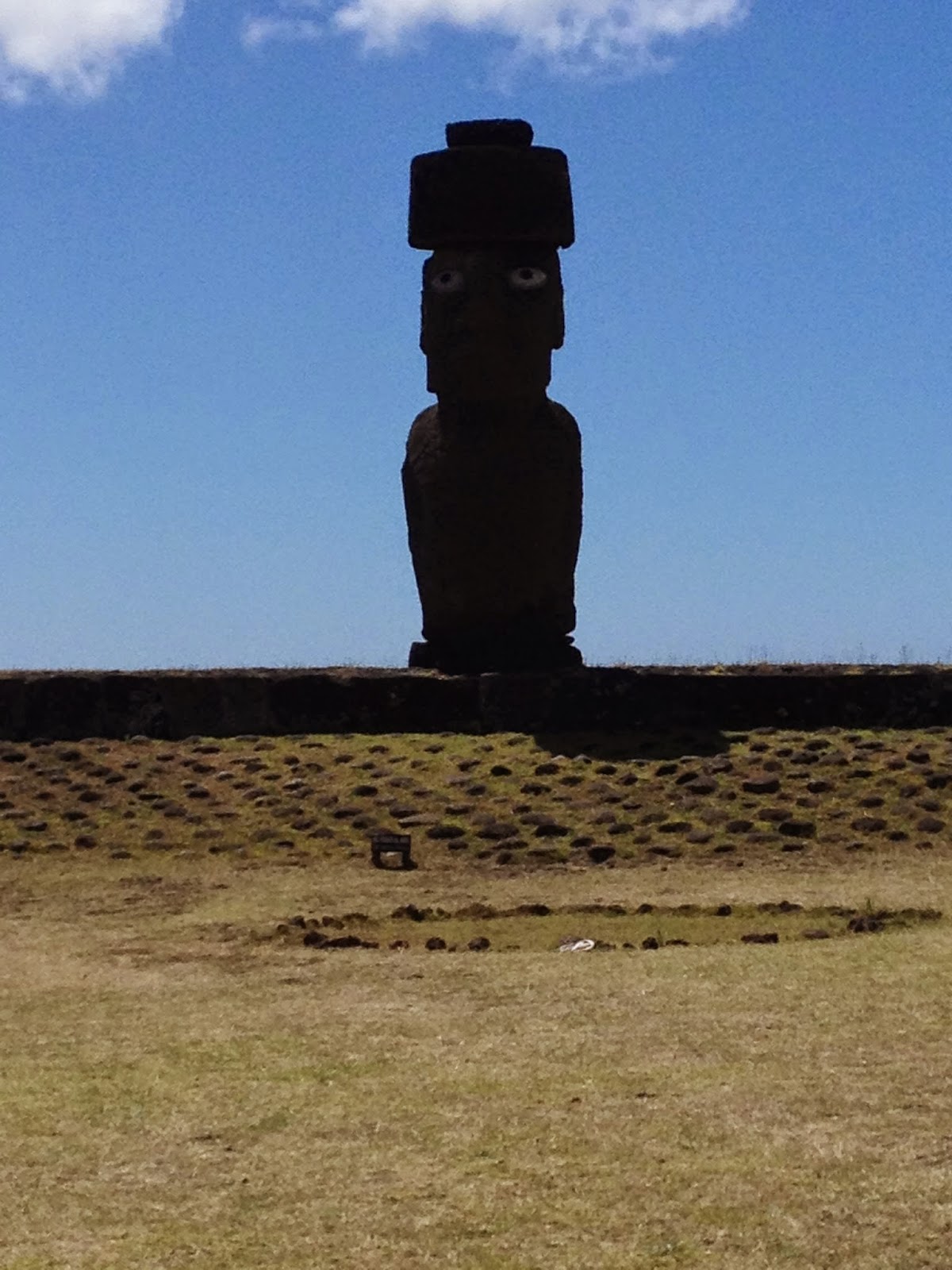


Heery and I agree that this was one of the most remarkable places we have visited in our various travels. It is certainly a place where we want to return.

Our ship awaits

Sunday, 2 November 2014

Thanksgiving - October, 2014

For those of you who are unaware or have perhaps forgotten, Canadian Thanksgiving falls in the early part of October. That being said, I am entitling this entry "Thanksgiving" for more than just this reason. I am thankful that I made it home in one piece. Now, don't get me wrong, the destination was very nice - it was the mode of transportation that creates the reaction that might seem a tad dramatic. 


Had I known onto what we were going to be required to embark, I do believe I would have seriously reconsidered my Thanksgiving getaway. The day was terribly overcast and rainy when we arrived at the tiny South Terminal in Vancouver. So, needless to say, we were already delayed. When the flight was finally announced, we and six other people - yes, six - were lined up and marched out to the far side of the tarmac by what appeared to be a fifteen year old intern or something. There sat a minuscule thing, resembling something akin to a Tonka toy with a couple of propellers and two little steps that folded out from the side of the hull. Shaken but not deterred, we took our seats in the very last row waiting for the pilot. Oh yes, you guessed it, it was the fifteen year old intern. This little putt-putt plane fish-tailed, dropped and bumped around for about 75 minutes until it found clear skies and a stick of gum sized air strip on which to land. We were so relieved until we saw the sign on the terminal building - Qualicum Beach - an airport on the east side of the island. The pilot was unable to get through the clouds and was forced to land elsewhere. This meant that we had a three hour shuttle trip ahead of us, dropping all passengers at their destinations along the way. This put us at our final destination after the kitchen had closed, leaving only bar food for sustenance.


This is not for the air/car/sea/motion sickness sufferer.

The trip back to Vancouver was equally terrifying due to driving, hammering rain, however, the trip was shorter since we actually did arrive back at Vancouver's South Terminal.

Going over
Coming back


Needless to say, the first morning at the Wickaninnish Inn was a late one. The hotel has done a very smart thing in that they serve breakfast/lunch together, lasting from 8am until 2pm. This gives one time to sleep in or to rise early and explore the shoreline or to relax in one's soaker tub and watch the surf hammer the rocks right below the window. 

I don't normally discuss a particular hotel but since this is the destination and it is internationally known, I feel that I should tout some of its virtues. Of course, the Inn is famous for its views - storm surge is all the rage here. As you can see, the focus is all on the coast.

We were in the Pointe building - on the left (courtesy of www.wickinn.com)


Large windows, fireplaces and beautiful natural cedar wood are everywhere, making for a warm environment in which to experience the Northern Pacific coast. Worn hewn beams and the orange glow from sconces and lamps reinforces the sense of bringing the outside in. A great example of this is the library in the Beach building (on the right). There aren't a large collection of books but there are games and DVD's for families to borrow and an enormous pair of binoculars on a tripod for exploring further out from the shore. With soft leather couches and indigenous patterned throw pillows, it makes the decision to hike out in the rain that much more difficult.


The views are what one comes for. And it's amazing how different the same vista can be depending on the weather or the time of day. When one wakes, the tide is far, far out, making it possible to walk across sandbars, explore the little tide pools and discover treasures on the beach. This is one of my favourite photos from this trip.


Yes, the ocean is out there - it's just way, way out there. And even though it's hard to see them, for people like my brother, this is surfing heaven. It isn't called Long Beach for nothing.

We truly did have a room with a view but it's anybody's guess what that view might be on any given day. From our comfortable balcony, we enjoyed our morning coffee and marvelled at how the colours and textures change according to the tide and the light.


The Pointe Restaurant is set up in a circular fashion, giving the view the primary focus during daylight hours and the awesome copper fireplace at night. Look back at the photo and you'll see the roundhouse sticking out of the rocks. Due to the special weekend, there was a lot of turkey on the menu in different forms but all of the ingredients here are locally sourced as much as possible and it's all incredibly fresh. They have a new supplier who makes their sausage just down the road, the mushrooms are wild and hand-picked, the halibut still has seawater on it and you could probably go out back and pick your own salad if you asked. And for those of you who haven't been to British Columbia, the wines of the Okanagan and from Vancouver and Salt Spring Islands are some of the finest you'll ever taste.


For all the trouble getting to and from the Wickaninnish Inn, the restfulness of the rooms, the stunning views, and the delicious food make it worth the struggle. But perhaps it would be easier in the summer. So, if you decide to go in storm season anyway, make sure you've got chains on your tires and gravlox in your bag.


Saturday, 30 August 2014

There are holidays and THEN there are holidays - Maui August, 2014

Recently, I posted an entry regarding my experience on Via Rail. This was the beginning of a very interesting - and lengthy - journey culminating in a river cruise down the Douro River in Northern Portugal. In addition to the train debacle, we enjoyed a two week Transatlantic cruise from Miami to Copenhagen, Denmark. This was followed by several days in Lisbon with fans from the Premiere League football (soccer) final prior to the aforementioned river cruise. The final leg was spent in London as is our usual routine. I counted it up and, during this six week period, we packed/unpacked 10 times. Don't get me wrong, it was a fascinating trip and I'm thrilled to have been able to do it but, truthfully, I was exhausted.

Today, I'm writing this entry from paradise. Now, THIS is a holiday. THIS is where one lies around like third base doing as little as possible. THIS is where there are no flight schedules (except coming in and going out), no meeting times, no reservations, no deadlines. Just bring a book and some music and get comfortable.

Aloha! Welcome to Maui - make yourself at home. Where the sound of the nearby surf lulls you to sleep and where the gentle cooing of doves awakens you to a new day.


This is my home for several weeks every summer - Napili Surf. You will find me (and my husband) on one of these chairs in a pair of sunglasses lying on a blue and white striped beach towel with ear buds in my ears and my kindle at the ready. Cooling trade winds blow fairly consistently insuring that I am seldom overheated. This almost always results in a refreshing nap - that is unless there happen to be a number of boisterous children nearby. This, fortunately, is not a common occurrence during this particular time of year.


And this is the view from the lawn. This is Napili Bay - full of sun worshippers, snorkelers,  boogie boarding children, fools on paddle boards for the first time (now, that's really funny to watch) and often, a black lab or two chasing a yellow tennis ball into the ocean. The waves are not usually strong enough for surfing as there is a reef a ways out that naturally protects the bay. But from time to time news travels the network that "surf's up" and the beach is suddenly full of long boards and long shorts for a few runs on the waves - no matter how short lived.

The property here at the Surf is a series of studio and one-bedroom condo units. There are two pools here for those of us who can no longer negotiate the sand on the beach. We have a full kitchen with all the conveniences - microwave, dishwasher, corkscrew, coffeemaker, etc. - making it easy to just stay home. We even have a self-serve laundry on site. There is a wonderful farmer's market twice a week just down the road and an excellent fish market with fresh catch every day. There are several full service supermarkets as well for all your grocery needs. For those Canadians reading this, the grocery stores even have a rather large section of alcohol removing the need for yet another shopping stop. Now, there are many fabulous restaurants here on the island, one of which I'll get to in the next entry, but my point is that there is no need to meet a reservation time if you just don't want to.


I realize there are those who couldn't stand to simply lie around all day. For you, there is plenty to see and do on the island of Maui. One of the oldest dormant volcanoes is right here - Haleakala is the place to go to experience one of the most glorious sunrises in the world. It stands at 13,000 feet, so if you go pre-dawn be sure to bring some warm clothes because it can be pretty cold up there. 

There is the road to Hana - a narrow drive, full of hairpin turns, through Maui's rainforest - stunning waterfalls and spectacular views will be your reward. Lahaina is the main town here on West Maui - full of shops and restaurants - and aging hippies. This is a fun place to be. For really upscale shopping, you need to go over to South Maui and the Shops at Wailea. This area has the most expensive resort hotels, thus the upscale shops. 

Many first-timers will take a helicopter tour of the island. While rather pricey, it's a great way to see the beautiful natural wonders of the valley isle. Another newcomer experience is a boat ride/snorkeling trip out to Molokini Reef. This is a large reef near Red Hill on the south side that has one of the most amazing collections of reef-dwelling creatures anywhere. In recent years, it has been terribly overcrowded but that may be changing. There are hiking trails, arboretums, black sand beaches, zip lines, horseback riding, parasailing adventures and, of course, golf. There seems to be something for every activity level on Maui.

If you want to see more than this, consider leaving the island for the day. There are three islands off the coast of South/West Maui that provide it some protection from Mother Nature. The island of Moloka'i is in the photo above - this is what we see from our little patch of beach. There are inter island flights and ferries from Lahaina every day that make it possible to make a short visit. Moloka'i is rather undeveloped, with a population of only 7000. And that's how the residents want it. They have fought tooth and nail to keep cruise ships from docking there, and they've won. The next island over is Lana'i. It's a small island with just a few resorts but they're beautiful developments and, if you're a golfer, this is the place to be. The third island, Kaho'olawe is, as yet, uninhabitable although the state is busy cleaning it up. During WWII, it was used as a testing area for land mines so, needless to say, it is not yet safe.


So, when is a holiday really a holiday? When you don't have to do anything at all - unless you choose to. 

Aloha!


Tuesday, 24 June 2014

3 Days in Hell on Via Rail - May, 2014

What a lovely, relaxing alternative to air travel - or so we thought - we're so sick of the stress and tension of long flights and airports. We decided to begin our 6 week European journey by taking Via Rail,Canada's passenger train, from Edmonton (it doesn't depart from Calgary) to Toronto to visit friends. We booked a cabin for 2, the top option for this transit, thinking it would be rather romantic. We felt quite confident as Via Rail is quite progressive in its attitude toward passengers with disabilities. Because of my limitations I need a travel companion to assist me so, with a letter from my doctor confirming this need, the company allows the companion to travel free of charge. Yeah, my husband and I went 2 for 1! The positive experience stops here.

We arrived at Edmonton's station around 10pm after having a nice dinner with a friend. The scheduled departure was midnight so we'd given ourselves plenty of time to check in our luggage and I was told that as I had a disability I would be able to board a little earlier. We needn't have worried. Eventually, an employee announced that the train was delayed coming in from Jasper due to a snow storm. Now, for those of you who are not familiar with this area of Canada, this is not at all unusual in May. Anyway, we sat and waited. There wasn't anything around the station and, aside from 2 vending machines, nothing inside the station either. And still we sat. And the employee came out again to announce further delay. Finally, the truth came out - the train was stopped just outside of the city while 2 freight trains travelled through. An appalling fact, that passenger trains have lowest priority - and one that we discovered would haunt us the whole way. So, some time after 2am the train arrived at Edmonton station. And we waited for passengers to disembark and for the train to be prepared. I won't say "cleaned" because I saw very little evidence of this. When we were finally invited to board, we stumbled down a dark, uncovered platform in the rain to our assigned car. And then we got to our cabin. I laughingly call it a cabin - more like a 35 sq. ft. closet with bunk beds. Seriously? Honestly, my closet at home is not much smaller. And seeing as I can't, my 72 year old husband got to crawl up the tiny ladder to his bunk. What is this, summer camp? Although what 8 year old is crawling into bed at 3am?

I will admit that the configuration was somewhat better during the day with the beds stored and 2 leather chairs in their place. And having a toilet and sink in the cabin was more convenient than having to bathe after a total stranger in the shower at the end of the car. Really? For space saving purposes, a counter piece flips up over the sink for extra storage but what a pain. If one actually puts items on it then every time the sink is needed the counter must be cleared in order to access it. This, of course, is so convenient in the middle of the night after using the bathroom. Are you sure you want to wash your hands?

The dining car was the other nightmare. Now, the food was rather good considering the limited space and resources and the serving staff was pretty efficient but being forced into a seat next to any rube is one sure way to ruin even the most gourmet meal. Frankly, people who travel by train on a regular basis, and there are a fair number, are not the most stimulating group. The conversation leaves something to be desired. Sadly, that's all there is on this journey other than reading. It's a good thing my husband and I are avid readers because there is no TV, internet, radio, newspapers - no connection to the outside world whatsoever; not even a satellite signal for a cell phone. And due to delays, the few stops we made - Saskatoon, Winnipeg - were in the wee hours of morning. So, am I going to wake up at 2am just to get off at Winnipeg for a cellphone signal? Who am I going to call?

Needless to say, this train is a petri dish. Windows can't be opened and, if you don't get off at the stops, the only fresh air available is by taking your life in your hands standing between the cars. To say that I was sick as a dog after we arrived in Toronto is an understatement - nothing but tiny germs floating all around us on that nasty little train.

I don't think it's an exaggeration to say that we couldn't wait to get off the thing. There's nothing to see outside in the way of scenery unless you enjoy endless prairie and nothing to do inside so... But wait! Remember the 3 hour into Edmonton? Well, as we chugged along over the course of 3 days, freight trains full of bitumen, grain, containers or whatever required us to pull onto a side track and stop, waiting for every one of them to pass. By the time we arrived at Union Station in Toronto, we were a paltry 7 hours late. Yes, I said 7. Scheduled to arrive at 9:20am but we finally crept into our berth at 4:30pm. Remember the "regulars" I mentioned? Not only were these folks unconcerned by this, they seemed impressed that we actually got there on the expected day. What's wrong with this picture?

This is my cautionary tale - just say no!

Tuesday, 2 July 2013

Lima, Peru May, 2013

We visited three sites in Lima - a very unusual city - that gave us a sense of its history and development.  Our first stop was at the Pacific Ocean - on which the Park of Love is perched.  The lovely place sits atop the cliffs of Chorrillos right at the ocean.  The park is set on several levels ultimately leading down to the beach.  One of its highlights is a series of mosaic tiles in several low walls, used to write romantic quotes.  A multi-coloured creation inspired by the great Gaudi of Barcelona and his beautiful Parc Guell.
The park is also full of glorious flower beds lining the stairs at each level.  The park's most inspiring element is a large elevated sculpture.  The Kiss, created by Victor Delfin in 1993, is the primary focus of the park both for the size of the piece and its title.  All the various parts of the park work hand in hand to make this experience a very welcoming, romantic atmosphere.


Playa Mayor provided some history of Lima - this is the main square and the birthplace of the city.  With a beautiful fountain in its centre, the plaza is surrounded by important buildings - the Cathedral of Lima, the Presidential Palace, the Archbishop's Palace and City Hall.  What is most interesting about this site is the variety of architecture.  Each side of the square seems to have been influenced by a different period.

Cathedral of Lima


Our most fascinating stop was at the Monastery of San Francisco - a structure designed in the high Spanish Baroque style, completed in 1774.  The monastery is devoted to the founder of the Dominican order, St. Francis of Assisi, with some 60 monks continuing to live on the premises.  In the public areas ('cause that's all I could see), one can view paintings by both local and European painters of the Mannerist style depicting the life of St. Francis.  Surrounding the courtyard are walls of hand painted tiles where azure blue and sunshine yellow dominate.  The monastery's most significant offering is the Museo de Catacombs.  Below the church itself are preserved catacombs, still housing femurs and skulls of centuries of believers.  Disturbingly, this is also where secret tunnels lead to what was a Tribunal of the Inquisition.  Unfortunately, no photographs are allowed so I am unable to provide evidence of my visit.

this is the entrance to the church itself

Lima is a fascinating city with numerous influences both from other places in South America as well as the rest of the world.  The people are most welcoming and they are eager to expose you to the delights of their metropolis - they are very proud of what Lima has to offer.  If you ever get the chance to travel here, take it!

Friday, 12 April 2013

Rio de Janeiro, Brazil December 2010

It's summertime in Rio on December so we experienced 35 degrees celcius (95 farenheit) temperatures during the day.  Quite a change from our Canadian winter.  Rio de Janeiro is a large city on the east coast of South America, making it a beach destination for many.  Their beaches are world famous - Ipanema (remember the song?) and Copacabana (I know Barry Manilow was singing about a bar but it got its name here!) - and there is a very active community here, not all of which is tourism.


Ipanema Beach

For miles along the street side of the beaches are wide pedestrian walkways, room for Brazilian sun worshippers and tourists alike.  If you intend to spend some time sunbathing in Rio there are some specific rules that must be followed so that you aren't immediately identified as a foreigner.  Now I know it's instantly a losing battle when you've spent several months with little sunshine and perhaps significant snowfall.  I know I'm almost glow-in-the-dark white and those tanning beds are frightening.  So, get out the sunscreen and keep this list close.

1.  Thong bikinis and speedos
     -ladies and gents, I know that most of us of a certain age would not be caught dead in these (I know I don't want to see it), however, you will stick out like a sore thumb in Rio if you wear your surfing shorts or your tankini and skirt.  Suits are sold all over the place in Rio and, unlike North America, they're dirt cheap.  So, if you want to hang out at the beach, you're going to have to suck it up (or in, as the case may be)!

2.  Sitting on the sand
     -now, there are different codes for men and women here and, finally, the ladies come out the winners - well, sort of.  There are no beach towels out there on the blazingly hot sand.  A commonly worn clothing item is acceptable for women to place between their tushy and the hot sand.  The colourful sarong or "kanga" is everywhere and very affordable.  Although many men also wear them, they are considered sissies if seen sitting on one on the beach.  So, what do the gentlemen do?  Well, either you withstand the heat of the bare sand on your scantilly clad behind or you'd better remember to bring your newspaper.  These appear to be the only acceptable methods other than standing.  Some men have been known to share just the corner of their female companion's kanga - but only 3%!

3.  Interaction on the beach
     -women are not to play frisbee or soccer on the beach, nor jog along the surf.  They are expected to lie about on kangas (either on their elbows or on their bellies) or sit in small groups with other women.  They are also not to be seen playing in the water with men.  Swimming is expected of the men but standing in the water about waist deep and giggling with her girlfriends is the ladies' way.

As this is a beach community, many hotels have areas set up near their location where guests can use beach chairs (for you ladies) and umbrellas.  I mean, really, is it worth suffering sunstroke to avoid being called a sissy or a gringo?

For those of you who insist on keeping your fitness routine while on holiday (come on), outdoor gyms can be found along the beaches.  But be ready to wear your tiny swimsuit and a loose tank top - that's what sitting on the stationary bikes.  So, probably you'll want to keep a towel nearby.  And NO Lululemon for you!

Let me just make it perfectly clear - these beach rules come from preparatory reading prior to our visit and observation while there.  Rest assured, I did not purchase a thong bikini (nor will I ever) or lay around like a blindingly white beached whale.  Not gonna happen.  My tankini and skirt did just fine at the pool on the roof of our hotel.


Metropolitan Cathedral of Rio de Janeiro

Designed by Edgar Fonceca and built between 1964 and 1979, this stunning structure is dedicated to St. Sebastian, the city's patron saint.  The building is architecturally reminiscent of a Mayan temple - conical in shape with textured squares.


It's a surprisingly modern looking house of worship.  Its most significant element is the stained glass panel that rises from floor to ceiling along three of the walls.  The design of each includes vibrant colours and abstract images - and when the light hits them, they create a heavenly atmosphere.  There is a beautiful altar in the centre of the sanitary and hanging from the expansive ceiling above is an amazing wooden crucifix.  As our visit was at Christmas, there was also a striking nativity set to one side of the altar.  This was quite a delightful surprise.

courtesy of www.wikipedia.com

courtesy of www.pbase.com


Sugarloaf Mountain

This hill rises out of the water in the shape of a refined loaf sugar and is comprised of granite and quartz.  One must access it from a shorter mound beside it via a glass cable car.  


This is primarily a sightseeing stop - the view of Rio is truly magnificent.  On one side, the ribbon beaches seem to go on for miles.  On the other side, one looks down on a bustling bay dotted with numerous private sailboats and yachts.


But the wider view gives the visitor a clear picture of Rio's neighbourhoods rising from the water's edge up into green, verdant hills.  Strangely, the homes with the best views in the hills are primarily in the shanty towns - the favelas - and the wealthier area is down nearer Ipanema Beach in the district of Leblon.  There are exquisite views of the city from the favelas if you're brave enough to risk entering them.  Unfortunately, they are somewhat crime-ridden.  We were able to safely stop at one point with an organized tour.

this is on the way to Corcovado


Corcovado

On the other side of the city, in Tijuca Forest National Park, is where you'll find the identifying mark of Rio de Janeiro.  Christ the Redeemer statue can be seen on this hill from anywhere in the city.  The hill itself rises 710m (2329 ft.) in the air and this imposing structure stands 38m (125 ft.) on the top.  


Standing at its base, it is enormous and very difficult to get a photo of the full length of the statue.  But even at such a size, Christ's face is gentle and calm and his arms extend out to the side, welcoming all who visit.


It is impossible to understand the magnitude of this piece until you stand at its feet looking up.  It is mammoth and it is lovely.  For those in Canada and those who are familiar with Inuit art, you will be surprised to know that this wondrous creation is carved from soapstone.


this is how far away we had to get for the Home Alone shot


Wednesday, 20 March 2013

New Orleans, Louisiana February 2013

This is an odd entry for me - I don't usually write about a city in which I've been a resident.  But seeing as I departed New Orleans in 1998 and Hurricane Katrina has visited since, I felt it was time to return to the Big Easy.

The city has lost something with the mass exit of many of its citizens from Katrina's disaster.  In some ways, it no longer feels like a living community but more like a theme park.  It does, however, retain its historic sites, legendary music and unique food.  In no way do I recommend avoiding this place because it has changed.  For those who have never lived in the City of New Orleans, it continues to be a wild and wonderful experience.

On this recent trip, my sightseeing was limited to the French Quarter but I feel compelled to provide an additional list of important venues that should be visited.

1.  New Orleans Museum of Art in City Park
2.  Audubon Zoo in the Uptown district
3.  Audubon Aquarium of the Americas at the base of Canal St.
4.  National World War II Museum in the Uptown district
5.  Jazz Music
     -Lafitte's Blacksmith Shop on Bourbon St.
     -Snug Harbor in the Faubourg Marigny

Lafitte's is in the French Quarter and is reputed to be the oldest building to be used as a bar in the US - built in the mid-18th century.  It is here where classic New Orleans jazz can be heard.  Snug Harbor has a marvellous reputation for contemporary jazz - Ellis Marsalis and Charmaine Neville are regulars here.  Its neighbourhood, the Faubourg Marigny, is on the opposite side of the Quarter from Canal St.

Note***Let me emphasize a warning here, as I do with all my friends and clients.  Under no circumstances are you to walk out of the French Quarter (between Canal St. and Esplanade Ave. and Decatur St. and Rampart St.) at night.  It doesn't matter if you're alone or in a group - GET IN A CAB!!  This is still an unpredictable city and during this last visit I met a man who had been mugged only the night before.

That being said, during the day, Magazine St. in the Uptown district is an amazing area for window shopping or even more.  If you are a collector of antiques, this is a must-see during your visit.

The French Quarter is also a wonderful place for exploration so wander around if you can.  Places like Faulkner House Books can be found in Pirates Alley - it is aptly named as it is actually in Faulkner's former home.  There are numerous sites affiliated with Tennessee Williams in the Quarter, even a walking tour that you can join to locate them.  Every March the city presents the Tennessee Williams Festival, a five day celebration of the playwright's life and works.  Numerous bookstores, antique shops, boutiques and, of course, untold numbers of restaurants provide a terrific day in this historic district.


Jackson Square is the heart of the French Quarter, sitting across from the Mississippi River on Decatur St.  Opposite the street side is St. Louis Cathedral (Harry Connick Jr. was married here) and along the adjacent sides are shops and restaurants and some of the city's most expensive condos.


In the centre of the square sits a beautiful little park complete with fountain.  It has been much improved and cleaned up since I was last there.


Outside the fence surrounding the park, the square is a mecca for people-watching.  Yes, there are some people who have fallen on hard times and are completely harmless.  There are magicians and tarot card readers and gypsies, painters and sketch artists.  They want your money but at least you'll have a good time spending it.  And there are always musicians on the benches, playing their famous second line jazz.  Jackson Square is a gathering place for just about every kind of person you can dream up (yes, even mimes!).

There is a world famous place that must be frequented by every first time visitor to the Quarter.  Directly across Decatur from the square is Cafe Du Monde.  You'll know it by its green and white striped awning.  Everyone needs to sit and experience their cafe au lait (with chicory) and beignets.  Yes, little puffy deep fried doughnut-like delights sprinkled with powdered sugar.  Oh, you just don't know... BUT, don't ever inhale as you're taking a bite.  It is powdered sugar, after all.

Now, on either side of the Cathedral are two buildings.  To the left (facing the Cathedral) is the Cabildo - in the 18th century it served as the seat of government under Spanish rule and then became City Hall before its current incarnation as a museum.  The Louisiana State Museum primarily houses three exhibits.  One deals with the politics and economics of the territory prior to the Louisiana Purchase, one deals with issues surrounding the Civil War and the rise of the Ku Klux Klan (nice), and the last one is a very informative presentation on antebellum life.


To the right of the Cathedral sits the Presbytere.  Although designed to match the Cabildo and house the Capuchin Monks, it was never used as a religious residence.  It was ultimately used by the Louisiana Supreme Court in the mid-19th century and today is a museum.  Its two exhibits address the city itself.  On the first floor is a very thorough discussion of the Hurricane Katrina disaster.  There are exhibits showing the levee failures and the measures used to rebuild.  Television news footage of rescues and human suffering are played in loops throughout the exhibit and there is a repeating audio loop of people who witnessed the storm and lived through it.  The second floor is much more light-hearted.  It is an amazing history of Mardi Gras presented in several rooms.  Each space houses parade photos, floats, some costumes, and other bling and throws from the many Krewes (or social clubs).  The display is both fun and informative.