Tuesday, 2 July 2013

Lima, Peru May, 2013

We visited three sites in Lima - a very unusual city - that gave us a sense of its history and development.  Our first stop was at the Pacific Ocean - on which the Park of Love is perched.  The lovely place sits atop the cliffs of Chorrillos right at the ocean.  The park is set on several levels ultimately leading down to the beach.  One of its highlights is a series of mosaic tiles in several low walls, used to write romantic quotes.  A multi-coloured creation inspired by the great Gaudi of Barcelona and his beautiful Parc Guell.
The park is also full of glorious flower beds lining the stairs at each level.  The park's most inspiring element is a large elevated sculpture.  The Kiss, created by Victor Delfin in 1993, is the primary focus of the park both for the size of the piece and its title.  All the various parts of the park work hand in hand to make this experience a very welcoming, romantic atmosphere.


Playa Mayor provided some history of Lima - this is the main square and the birthplace of the city.  With a beautiful fountain in its centre, the plaza is surrounded by important buildings - the Cathedral of Lima, the Presidential Palace, the Archbishop's Palace and City Hall.  What is most interesting about this site is the variety of architecture.  Each side of the square seems to have been influenced by a different period.

Cathedral of Lima


Our most fascinating stop was at the Monastery of San Francisco - a structure designed in the high Spanish Baroque style, completed in 1774.  The monastery is devoted to the founder of the Dominican order, St. Francis of Assisi, with some 60 monks continuing to live on the premises.  In the public areas ('cause that's all I could see), one can view paintings by both local and European painters of the Mannerist style depicting the life of St. Francis.  Surrounding the courtyard are walls of hand painted tiles where azure blue and sunshine yellow dominate.  The monastery's most significant offering is the Museo de Catacombs.  Below the church itself are preserved catacombs, still housing femurs and skulls of centuries of believers.  Disturbingly, this is also where secret tunnels lead to what was a Tribunal of the Inquisition.  Unfortunately, no photographs are allowed so I am unable to provide evidence of my visit.

this is the entrance to the church itself

Lima is a fascinating city with numerous influences both from other places in South America as well as the rest of the world.  The people are most welcoming and they are eager to expose you to the delights of their metropolis - they are very proud of what Lima has to offer.  If you ever get the chance to travel here, take it!

Friday, 12 April 2013

Zaza Bistro Tropical, Rio de Janeiro

This place is eclectic and funky, just the venue to be in the Ipanema district.  It sits on a corner with cushioned benches outside the gate at street level.  Up the steps are wonderful seats on the wrap around porch for waiting or enjoying a drink with friends.  There are wonderful coloured twinkle lights hanging from the house's white trim and its azure blue facade is most inviting.  

Once inside, you can enjoy your meal at the charming bistro tables downstairs or you can sit on the cushions on the floor at the tables upstairs.  No matter where you choose, the walls are decorated with painted phrases of writers and philosophers and shadow boxes of every shape and size, containing items from all the world's religions.

This diversity is clearly reflected in the myriad of ingredients and cuisine styles.  I started with whitefish ceviche with fruit and cilantro, using wafer-thin potato crisps as a spoon.  I really appreciate ceviche, the fish (or scallop) is so tender and the flavours - lime, for instance - blend so well.  The flavours chosen are also the ingredients used to cure the fish or scallop.  Heery had Zaza's take on the Caprese salad.  This time, a whole tomato was hollowed out and filled with black olive tapenade.  How I love olives!

The mains were equally interesting.  I had flambeed shrimp with risotto al limone (lemon) - it was deliciously rich.  Heery had a special whitefish with a puree of bananas and...fresh (I'll say it again, fresh) hearts of palm.  This is a Brazilian wonder - no pulling mushy stalks out of the can.  Brazil is its home turf.  It was unbelievable!

We finished with a fabulous dessert.  A petit gateau filled with caramel and green tea ice cream on the side.  Since caramel and ice cream are two of my dear husband's favourite sweets, this was the perfect choice.

This meal was a terrific way to begin our trip as it was a lovely two block walk from our hotel on our very first night in Rio.


courtesy of www.restauranting.com.br

Rio de Janeiro, Brazil December 2010

It's summertime in Rio on December so we experienced 35 degrees celcius (95 farenheit) temperatures during the day.  Quite a change from our Canadian winter.  Rio de Janeiro is a large city on the east coast of South America, making it a beach destination for many.  Their beaches are world famous - Ipanema (remember the song?) and Copacabana (I know Barry Manilow was singing about a bar but it got its name here!) - and there is a very active community here, not all of which is tourism.


Ipanema Beach

For miles along the street side of the beaches are wide pedestrian walkways, room for Brazilian sun worshippers and tourists alike.  If you intend to spend some time sunbathing in Rio there are some specific rules that must be followed so that you aren't immediately identified as a foreigner.  Now I know it's instantly a losing battle when you've spent several months with little sunshine and perhaps significant snowfall.  I know I'm almost glow-in-the-dark white and those tanning beds are frightening.  So, get out the sunscreen and keep this list close.

1.  Thong bikinis and speedos
     -ladies and gents, I know that most of us of a certain age would not be caught dead in these (I know I don't want to see it), however, you will stick out like a sore thumb in Rio if you wear your surfing shorts or your tankini and skirt.  Suits are sold all over the place in Rio and, unlike North America, they're dirt cheap.  So, if you want to hang out at the beach, you're going to have to suck it up (or in, as the case may be)!

2.  Sitting on the sand
     -now, there are different codes for men and women here and, finally, the ladies come out the winners - well, sort of.  There are no beach towels out there on the blazingly hot sand.  A commonly worn clothing item is acceptable for women to place between their tushy and the hot sand.  The colourful sarong or "kanga" is everywhere and very affordable.  Although many men also wear them, they are considered sissies if seen sitting on one on the beach.  So, what do the gentlemen do?  Well, either you withstand the heat of the bare sand on your scantilly clad behind or you'd better remember to bring your newspaper.  These appear to be the only acceptable methods other than standing.  Some men have been known to share just the corner of their female companion's kanga - but only 3%!

3.  Interaction on the beach
     -women are not to play frisbee or soccer on the beach, nor jog along the surf.  They are expected to lie about on kangas (either on their elbows or on their bellies) or sit in small groups with other women.  They are also not to be seen playing in the water with men.  Swimming is expected of the men but standing in the water about waist deep and giggling with her girlfriends is the ladies' way.

As this is a beach community, many hotels have areas set up near their location where guests can use beach chairs (for you ladies) and umbrellas.  I mean, really, is it worth suffering sunstroke to avoid being called a sissy or a gringo?

For those of you who insist on keeping your fitness routine while on holiday (come on), outdoor gyms can be found along the beaches.  But be ready to wear your tiny swimsuit and a loose tank top - that's what sitting on the stationary bikes.  So, probably you'll want to keep a towel nearby.  And NO Lululemon for you!

Let me just make it perfectly clear - these beach rules come from preparatory reading prior to our visit and observation while there.  Rest assured, I did not purchase a thong bikini (nor will I ever) or lay around like a blindingly white beached whale.  Not gonna happen.  My tankini and skirt did just fine at the pool on the roof of our hotel.


Metropolitan Cathedral of Rio de Janeiro

Designed by Edgar Fonceca and built between 1964 and 1979, this stunning structure is dedicated to St. Sebastian, the city's patron saint.  The building is architecturally reminiscent of a Mayan temple - conical in shape with textured squares.


It's a surprisingly modern looking house of worship.  Its most significant element is the stained glass panel that rises from floor to ceiling along three of the walls.  The design of each includes vibrant colours and abstract images - and when the light hits them, they create a heavenly atmosphere.  There is a beautiful altar in the centre of the sanitary and hanging from the expansive ceiling above is an amazing wooden crucifix.  As our visit was at Christmas, there was also a striking nativity set to one side of the altar.  This was quite a delightful surprise.

courtesy of www.wikipedia.com

courtesy of www.pbase.com


Sugarloaf Mountain

This hill rises out of the water in the shape of a refined loaf sugar and is comprised of granite and quartz.  One must access it from a shorter mound beside it via a glass cable car.  


This is primarily a sightseeing stop - the view of Rio is truly magnificent.  On one side, the ribbon beaches seem to go on for miles.  On the other side, one looks down on a bustling bay dotted with numerous private sailboats and yachts.


But the wider view gives the visitor a clear picture of Rio's neighbourhoods rising from the water's edge up into green, verdant hills.  Strangely, the homes with the best views in the hills are primarily in the shanty towns - the favelas - and the wealthier area is down nearer Ipanema Beach in the district of Leblon.  There are exquisite views of the city from the favelas if you're brave enough to risk entering them.  Unfortunately, they are somewhat crime-ridden.  We were able to safely stop at one point with an organized tour.

this is on the way to Corcovado


Corcovado

On the other side of the city, in Tijuca Forest National Park, is where you'll find the identifying mark of Rio de Janeiro.  Christ the Redeemer statue can be seen on this hill from anywhere in the city.  The hill itself rises 710m (2329 ft.) in the air and this imposing structure stands 38m (125 ft.) on the top.  


Standing at its base, it is enormous and very difficult to get a photo of the full length of the statue.  But even at such a size, Christ's face is gentle and calm and his arms extend out to the side, welcoming all who visit.


It is impossible to understand the magnitude of this piece until you stand at its feet looking up.  It is mammoth and it is lovely.  For those in Canada and those who are familiar with Inuit art, you will be surprised to know that this wondrous creation is carved from soapstone.


this is how far away we had to get for the Home Alone shot


Wednesday, 20 March 2013

Stella! New Orleans

The dining room is a beautiful combination of traditional decor - taupe leather chairs with studded accents - paired with contemporary elements.  Above the fireplace is an arrangement of brushed steel stalk and trunk inspired pieces.  The most striking item is an enormous white ceramic vase on the centre table that is simply full of incredible, colourful fresh flowers.

Our meal was a delight.  We chose their four course menu - as each course had several selections from which to choose, we had them pair the wines.  We had mentioned our love of Spanish wines, so the staff made special pairings with only Spanish wine.  We'd never had any of them and they were terrific.  

My first course was devilled egg with caviar and champagne gelee.  'Nuff said.  Heery started with foie gras (you know how he hates that stuff) and a mustard sauce with fruit. The second course was a fantastic Asian chili prawn dish - three gulf shrimp on a slice of baguette - all drenched in a spicy chili sauce.  So yummy!  We both had this course and the third one.  Flounder with mussels, clams, calamari, shrimp and Nantucket scallops in a coconut and kaffir lime broth.  Each piece was perfectly tender but the scallops had a succulent sweetness to them that was quite unique.  The fourth course was rather unusual.  I had a citrus verrine with honey custard - this was a kind of ice creamy sauce on top of this lovely sticky custard.  Heery had a Stella version of a warm, moist almond pound cake.

All of our food choices had elements of classic New Orleans cuisine combined with more modern cooking techniques.  The whole staff was very expert and inviting - we felt most welcome and comfortable.  You simply must go!


courtesy of www.bloomberg.com

New Orleans, Louisiana February 2013

This is an odd entry for me - I don't usually write about a city in which I've been a resident.  But seeing as I departed New Orleans in 1998 and Hurricane Katrina has visited since, I felt it was time to return to the Big Easy.

The city has lost something with the mass exit of many of its citizens from Katrina's disaster.  In some ways, it no longer feels like a living community but more like a theme park.  It does, however, retain its historic sites, legendary music and unique food.  In no way do I recommend avoiding this place because it has changed.  For those who have never lived in the City of New Orleans, it continues to be a wild and wonderful experience.

On this recent trip, my sightseeing was limited to the French Quarter but I feel compelled to provide an additional list of important venues that should be visited.

1.  New Orleans Museum of Art in City Park
2.  Audubon Zoo in the Uptown district
3.  Audubon Aquarium of the Americas at the base of Canal St.
4.  National World War II Museum in the Uptown district
5.  Jazz Music
     -Lafitte's Blacksmith Shop on Bourbon St.
     -Snug Harbor in the Faubourg Marigny

Lafitte's is in the French Quarter and is reputed to be the oldest building to be used as a bar in the US - built in the mid-18th century.  It is here where classic New Orleans jazz can be heard.  Snug Harbor has a marvellous reputation for contemporary jazz - Ellis Marsalis and Charmaine Neville are regulars here.  Its neighbourhood, the Faubourg Marigny, is on the opposite side of the Quarter from Canal St.

Note***Let me emphasize a warning here, as I do with all my friends and clients.  Under no circumstances are you to walk out of the French Quarter (between Canal St. and Esplanade Ave. and Decatur St. and Rampart St.) at night.  It doesn't matter if you're alone or in a group - GET IN A CAB!!  This is still an unpredictable city and during this last visit I met a man who had been mugged only the night before.

That being said, during the day, Magazine St. in the Uptown district is an amazing area for window shopping or even more.  If you are a collector of antiques, this is a must-see during your visit.

The French Quarter is also a wonderful place for exploration so wander around if you can.  Places like Faulkner House Books can be found in Pirates Alley - it is aptly named as it is actually in Faulkner's former home.  There are numerous sites affiliated with Tennessee Williams in the Quarter, even a walking tour that you can join to locate them.  Every March the city presents the Tennessee Williams Festival, a five day celebration of the playwright's life and works.  Numerous bookstores, antique shops, boutiques and, of course, untold numbers of restaurants provide a terrific day in this historic district.


Jackson Square is the heart of the French Quarter, sitting across from the Mississippi River on Decatur St.  Opposite the street side is St. Louis Cathedral (Harry Connick Jr. was married here) and along the adjacent sides are shops and restaurants and some of the city's most expensive condos.


In the centre of the square sits a beautiful little park complete with fountain.  It has been much improved and cleaned up since I was last there.


Outside the fence surrounding the park, the square is a mecca for people-watching.  Yes, there are some people who have fallen on hard times and are completely harmless.  There are magicians and tarot card readers and gypsies, painters and sketch artists.  They want your money but at least you'll have a good time spending it.  And there are always musicians on the benches, playing their famous second line jazz.  Jackson Square is a gathering place for just about every kind of person you can dream up (yes, even mimes!).

There is a world famous place that must be frequented by every first time visitor to the Quarter.  Directly across Decatur from the square is Cafe Du Monde.  You'll know it by its green and white striped awning.  Everyone needs to sit and experience their cafe au lait (with chicory) and beignets.  Yes, little puffy deep fried doughnut-like delights sprinkled with powdered sugar.  Oh, you just don't know... BUT, don't ever inhale as you're taking a bite.  It is powdered sugar, after all.

Now, on either side of the Cathedral are two buildings.  To the left (facing the Cathedral) is the Cabildo - in the 18th century it served as the seat of government under Spanish rule and then became City Hall before its current incarnation as a museum.  The Louisiana State Museum primarily houses three exhibits.  One deals with the politics and economics of the territory prior to the Louisiana Purchase, one deals with issues surrounding the Civil War and the rise of the Ku Klux Klan (nice), and the last one is a very informative presentation on antebellum life.


To the right of the Cathedral sits the Presbytere.  Although designed to match the Cabildo and house the Capuchin Monks, it was never used as a religious residence.  It was ultimately used by the Louisiana Supreme Court in the mid-19th century and today is a museum.  Its two exhibits address the city itself.  On the first floor is a very thorough discussion of the Hurricane Katrina disaster.  There are exhibits showing the levee failures and the measures used to rebuild.  Television news footage of rescues and human suffering are played in loops throughout the exhibit and there is a repeating audio loop of people who witnessed the storm and lived through it.  The second floor is much more light-hearted.  It is an amazing history of Mardi Gras presented in several rooms.  Each space houses parade photos, floats, some costumes, and other bling and throws from the many Krewes (or social clubs).  The display is both fun and informative.


Monday, 11 February 2013

Akbiyik Fish Restaurant, Istanbul

I've seen some very negative reviews of this place online but, truly, I cannot understand why.  We not only had a wonderful meal, we were treated very well by several lovely gentlemen.

Akbiyik Fish Restaurant is located on the corner of a main street in Sultanahmet but in a less trafficked area so it was less touristy.  Along the outside wall of the restaurant on its side street sat three men providing some traditional Turkish music.  Because it was outside, we could enjoy it without feeling overwhelmed by it.  At the entrance, there are a couple of steps that bring you in slightly below street level.  It's interesting to people watch from this vantage point.  The interior isn't much to look at, very simple, but it's the food...!

The first course was a tray of mezes (or small plates) from which we could choose as many as we wished.  The three we ate were terrific - a roasted aubergine (eggplant), a potato and caper salad and a marinated octopus.  We ordered a local Turkish wine with this - something similar to a sauvignon blanc and very nice.  As we sipped, a fresh platter of fish was brought out for us to choose.  We picked a glistening white grouper that was baked in a salt dome.

This is a bit of a lengthy process, so while we waited, we were brought a plate of THE MOST TENDER calamari rings - exquisite.  When the fish came out, two men set it on fire and then proceeded to chisel the dome open.  Once the largest chunks were removed, another man removed the fish and filleted it.  Along with the fillets, we were served the cheeks of the grouper and the shrimp and mushroom stuffing that had steamed inside.  Mr. Grouper was so large that we had to forgo dessert.  But what a great meal!  This was a lovely change from the more touristed places in Istanbul.


Istanbul, Turkey May 2011

Istanbul is a cornucopia of sights, sounds, scents, flavours and textures.  From the hundreds of mosque minarets, to the cobblestones of the streets, the aromas of perfume oil to the flavours of spices, the sounds of the muezzins calling Muslims to prayer - this ancient place is steeped in a unique history.


courtesy of www.lonelyplanet.com


Our first morning in Istanbul was a bit jarring.  If you don't reside in a place that caters primarily to a Muslim population, then you are wholly unprepared to be awakened at 5am to the sound of an amplified muezzin calling the faithful to morning prayers.  We were happily ensconced in a hotel in the Sultanahmet district, in the heart of the Old City.  So, there must be fifty mosques (not much of an exaggeration) in this area and, at the crack of dawn (or before), this cry comes very early.  We, frankly, had forgotten about this practice so we were rudely awakened this first morning - our own fault!


The Blue Mosque

It was very appropriate, then, that our first visit was to the Blue Mosque.  Built in the first half of the 16th century, the young Sultan Ahmet I was determined that his new mosque would be more glorious than the nearby AyaSofya (now a museum).  That is why the Blue Mosque boasts six minarets instead of the usual four.  


And the exterior appointments are merely the start.  We made our way into its courtyard and up a flight of stairs.  Along this outer corridor we were given a plastic bag in which to carry our shoes while inside.  Once in the domed sanctuary, you notice long, low bench-like wooden pieces.  These, I was informed, were for worshippers to place the bag of shoes during a service.


Well, Sultan Ahmet certainly succeeded here.  The domes overhead are stunning, covered in gold filigree - verses from the Quran.  And twinkling stained glass windows all around.


The carpet is a claret red dotted with the blue tulips.  It's replaced often when it begins to look worn.  The carpet was a gift to the Mosque from its faithful followers.


But the most phenomenal element is the collection of 20,000 hand-painted ceramic tiles, depicting 50 different tulip designs (seen around the domes above).  This flower became known as the Flower of the Gods over time so it holds a reverent place here.  

An interesting side note:  the tulip did not originate in Holland.  It is thought to have been cultivated by the Turks on 1000 AD.  It wasn't until 500-600 years later that the Dutch became obsessed with the bloom and began their own industry in Northern Europe by bringing seeds from Turkey.


The Bosphorous Strait

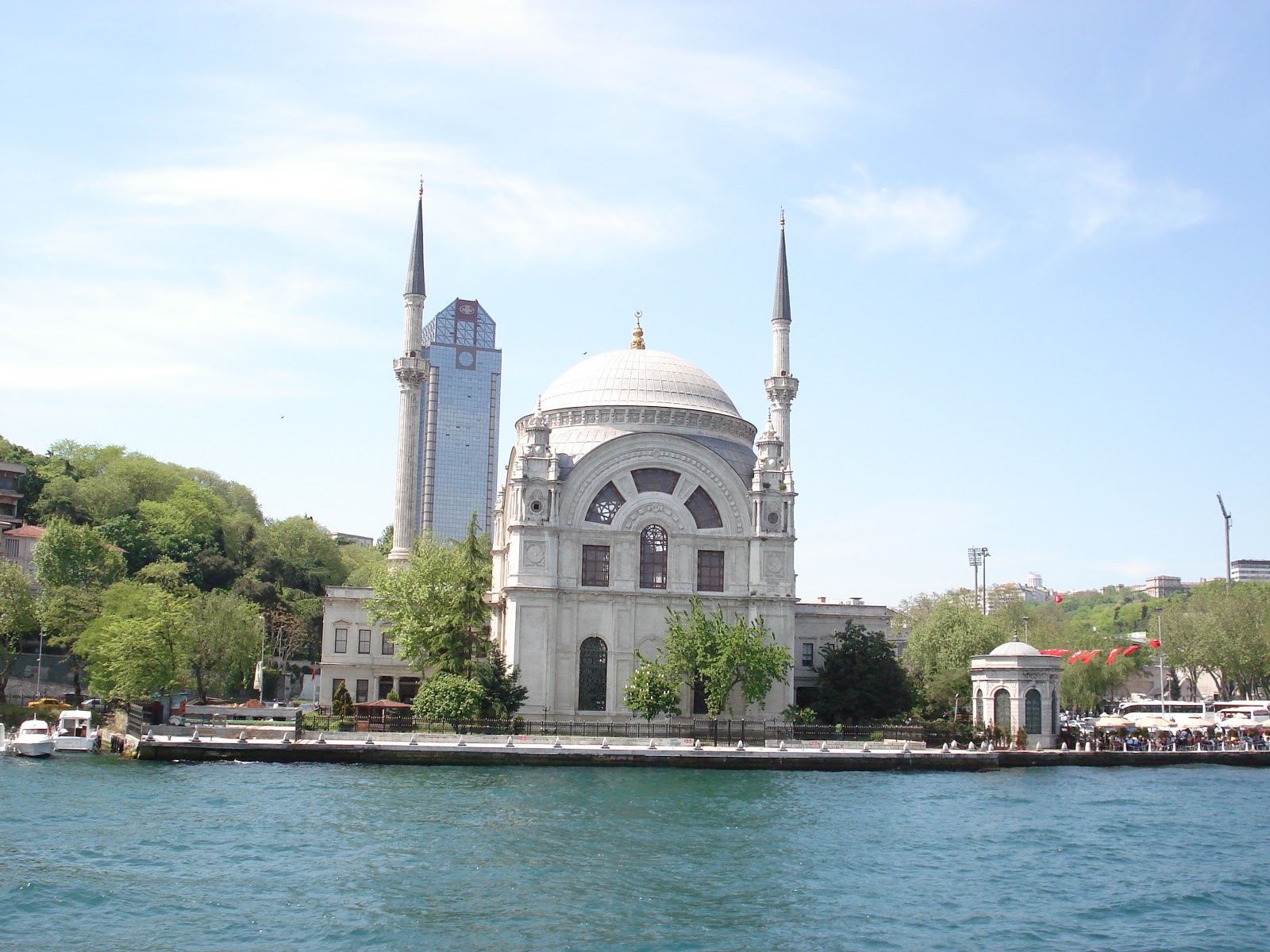
The Bosphorous Strait runs alongside Istanbul - separating the continents of Europe and Asia.  This body of water connects the Black Sea to the Aegean Sea (via the Dardanelles). Our boat ride took place on a perfectly beautiful day - nothing but a few white puffy clouds in a bright blue sky.  It was rather a breezy journey so you literally had to hold on to your hat.  The tour took us first toward the Black Sea along the European side, showing the beautiful homes and hotels along the way.


As we approached the entrance to the Black Sea, our vessel crossed over and proceeded back towards Istanbul along the Asian side.  The lovely homes here had a different architecture but certainly not what westerners typically think of as Asian.


During our journey, we passed under the Bosphorous Bridge.  Built in 1973, this suspension bridge connects the two continents.  For many years, this was the longest suspension bridge outside of the United States.


The Spice Bazaar

This market is an amazing gathering place for many different cultures.  Baseball caps shop right beside hijabs - in perfect peace.  Just entering through its beautiful archway, the senses are immediately heightened.  Numerous stalls present little hills of multicoloured spices - the scents of curry, cumin, saffron, pepper and coriander are all prominent here.  I challenge you to name a spice that is not present.


Many owners highlight their perfume oils - the one I noticed most was rose petal.  When it's a pure oil, it doesn't smell like your dear, old grandmother.  I was tempted by our guide to try real, handmade Turkish Delight and I discovered that I loved it.  So much so, in fact, that I purchased a box of pomegranate with pistachio.  The flavours are many and the owners are happy to give you a taste (or 2 or 3).  

There are other stalls along the walk that sell teas and coffees, belly dancing scarves and veils, and other trinkets and souvenirs.  Almost anything you can dream up.  While I shopped in one stall, I was treated to a little straw seat stool where I sat and enjoyed a cup of warm spiced apple tea.  There were several older women doing the same (hmm...I wonder what that means for me!) - like queens in their black hijabs.  It was a wonderful experience for all five of my senses.